Data collection, procedure, and instrumentation
In research, the data gathering procedure is a key step that outlines how information will be collected to answer the research questions. Choosing the right methods, tools, and steps for gathering data ensures that researchers obtain accurate and relevant information. By following a clear and organized data gathering procedure, researchers can maintain the validity and reliability of their findings.
Lesson objectives
At the end of the lesson, you should be able to:
- enumerate steps in data gathering procedure in research;
- differentiate the various types of data gathering methods and their tools and instruments; and
- select or create appropriate data-gathering methods and instruments for their research purposes.
Data collection is a systematic process of gathering observations or measurements. Whether you are performing research for business, governmental or academic purposes, data collection allows you to gain first-hand knowledge and original insights into your research problem (Scribbr, 2022).
Before you begin collecting data, you need to consider:
- The aim of research
- The type of data that you will collect
- The methods and procedures you will use to collect, store, and process the data
- Develop your data collection instrument and materials.
- Seek permission from the authorities.
- Select and screen the population using appropriate sampling technique.
- Train the raters, observers, assistants, and other research personnel.
- Obtain informed consent from participants.
- Pilot test the instruments.
- Provide instructions to the participants.
- Administer the instrument, and implement the intervention or treatment, if applicable.
- As much as possible, utilize triangulation.
- Immediately encode and archive your data.
- Safeguard the confidentiality of your data.
- Later, examine and analyze your data using the appropriate statistical tools.
| Data Collection Method | Description | Example |
|---|---|---|
| Surveys | Gather information through structured questionnaires, often with closed-ended questions. | Customer satisfaction survey with rating scales |
| Interviews | Conduct one-on-one or group discussions to gather in-depth qualitative data. | Job interviews to understand candidate experiences. |
| Observations | Systematic recording of behavior, events, or occurrences in a natural setting. | Classroom observations to study student behavior. |
| Experiments | Manipulative variables to observe their effect on outcomes under controlled conditions. | Drug trials to assess the efficacy of new medication. |
| Case Studies | In-depth analysis of a single individual, group, or phenomenon. | Studying the impact of a specific policy on a community. |
| Content analysis | Analyze and quantify the content of text, audio, or visual materials. | Analyzing new articles to identify media bias. |
| Etnography | Immersive study of a culture or community to understand behaviors and practices. | Living among a community to study their daily routines. |
| Surveillance | Systematic monitoring and collection of data over time. | Public health surveillance for disease outbreak detection. |
| Focus Groups | Facilitated group discussions to gather opinions and insights. | Testing consumer reactions to a new product in a focus group. |
| Social Media Analysis | Analyzing social media content to understand trends and opinions. | Sentiment analysis of Twitter data during a political event. |
1. Individual Interviews
Interviews are a qualitative data collection method that allows researchers to gather detailed, personal insights.
Types of Interviews
In a structured interview, the questions and their order are predetermined. The interviewer’s role is limited to providing clarification if needed and probing for more detailed responses if the answers are vague.
A semi-structured interview includes a set of planned questions, but the interviewer has flexibility to adjust the wording and sequence based on the flow of the conversation.
An in-depth interview is the most flexible and least formal type, where both the questions and their phrasing are not predetermined. This type is best for gathering complex, detailed information and is particularly useful for exploring opinion-based topics.
Advantages of Interviews
- Collect complete information with greater understanding.
- It is more personal, as compared to questionnaires, allowing us to have higher response rates.
- It allows more control over the order and flow of questions.
- We can introduce necessary changes in the interview schedule based on initial results (which is not possible in the case of a questionnaire study/survey).
Disadvantages
- Analyzing qualitative data can be time-consuming and complex.
- Conducting interviews with large groups is labor-intensive.
- Risk of bias is high due to fatigue and becoming too involved with interviewees.
When Useful
- Exploring personal experiences or sensitive topics.
- Gathering in-depth information on complex issues that surveys cannot capture.
Challenges
- Can be expensive, labor intensive, and time consuming.
- Selective hearing on the part of the interviewer may miss information that does not conform to pre-existing beliefs.
- Cultural sensitivity: e.g., gender issues.
2. Focus Group Discussion (FGD)
A focus group discussion is a structured yet dynamic method of gathering data, where a facilitator leads a conversation around a specific topic. Participants are encouraged to share their thoughts and opinions, generating rich, narrative data through group interaction. FGDs are especially valuable for exploring topics in-depth and understanding diverse perspectives within a social or cultural context.
Key Features of FGD
- The facilitator guides the discussion by posing questions to elicit participants' thoughts and opinions.
- The group setting fosters openness, allowing participants to build on each other's responses, enrich the discussion, and activate forgotten details.
- The group dynamic enables validation of individual opinions against the collective views, enhancing the reliability of insights.
- A well-organized FGD goes beyond a simple question-and-answer format, creating a conversational environment that explores nuances of the topic.
Benefits of FGDs
- Group dynamics widen the range of responses, uncover forgotten details, and lower inhibitions, especially for sensitive topics.
- FGDs can be conducted more quickly and with fewer resources compared to in-depth individual interviews.
- The process and questions can be adapted as the discussion progresses.
- The interactive nature makes FGDs enjoyable for participants, often yielding more candid insights.
Applications of FGDs are especially useful for
- Understanding shared values and beliefs within a community.
- Comparing perspectives and experiences among different individuals.
- Exploring delicate issues in a supportive group setting.
- Revealing how people talk about an issue.
Challenges in FGDs
- The volume and complexity of narrative data require extensive analysis.
- Participants may not represent the broader population, potentially biasing results.
- The facilitator or dominant group members may skew the discussion, limiting diverse perspectives.
3. Observations
Observations are a key qualitative research method that allows researchers to uncover implicit details of a situation by watching and listening to participants in their natural settings. This method is particularly valuable for understanding behaviors, interactions, and environments that might not be revealed through interviews or surveys.
Types of Observations
Observational techniques vary in terms of the researcher’s visibility and level of involvement:
The researcher becomes part of the group or setting being studied. This method enables the researcher to gain insider perspectives and experience the context firsthand.
The researcher remains an outsider, observing without direct interaction. This technique minimizes influence on participants, preserving the natural behavior of the group.
Tools for Documentation
- Field Notes: Detailed written accounts of observations, including descriptions of behaviors, interactions, and settings.
- Visual Media: Photographs or video recordings can supplement field notes, providing a richer and more permanent record of the observed phenomena.
Advantages of Observation
- It is the most direct measure of behavior.
- It provides direct information.
- It is easy to complete and is efficient.
- It can be used in natural or experimental settings.
Disadvantages of Observation
- It may require training.
- It is susceptible to bias.
- Observer’s presence may create an artificial situation.
- It can potentially overlook meaningful aspects.
- It is open to misinterpretation.
- It is difficult to analyze.
4. Surveys or Questionnaire
Surveys, also called questionnaires, are widely used in quantitative research. This is a powerful tool for collecting both subjective and objective data, helping to gather comprehensive and accurate information in a logical manner. It is especially effective in large sample populations, where responses can provide statistically significant results, even with limited resources. Additionally, the questionnaire format supports the protection of participants' privacy, as responses can be anonymous.
In a group setting, the interaction and dynamics between members can enhance the quality and quantity of the information obtained, as participants may feel more comfortable sharing their thoughts.
Questionnaires can be
- Structured: Closed-ended questions with predefined options, suitable for quantitative research.
- Unstructured: Open-ended questions allowing free responses, ideal for qualitative research.
Before Writing the Questionnaire
Before drafting the questionnaire, the researcher should carefully define its content. Questions must be directly related to the research hypotheses or questions established during the research design phase. These questions can take two primary forms:
- Open-ended questions: These allow respondents to answer in their own words, providing richer qualitative data.
- Closed-ended questions: These typically include multiple-choice formats, making it easier to quantify and analyze responses.
When writing the questionnaire, it is important to consider several key factors:
- Clarity: Questions should be clear and easy to understand.
- Phrasing: Be mindful of how questions are phrased to avoid confusion or bias.
- Sensitivity: Sensitive topics should be approached carefully.
- Hypothetical questions: These should be avoided if possible, as they may lead to speculative or inaccurate responses.
Why Pilot Test the Questionnaire?
To ensure the effectiveness of the questionnaire, it is essential to conduct a pilot test. This pre-testing phase helps identify and address any confusing or unclear aspects of the instrument. Participants for the pilot test should be randomly selected from the study population. The results from the pilot test provide valuable feedback on the questionnaire’s reliability. Additionally, experts in the field may be consulted to assess the validity of the questionnaire.
Advantages of Using a Questionnaire
- Large-scale Data Collection: Questionnaires allow researchers to gather data from a large sample, providing a broad view of the population’s characteristics.
- Statistical Significance: The data collected is often statistically significant, especially when resources are limited.
- Privacy Protection: Respondents are assured of confidentiality, encouraging honest and open responses.
- Versatility: Questionnaires are suitable for both qualitative and quantitative data collection, though they are particularly effective for gathering quantitative data.
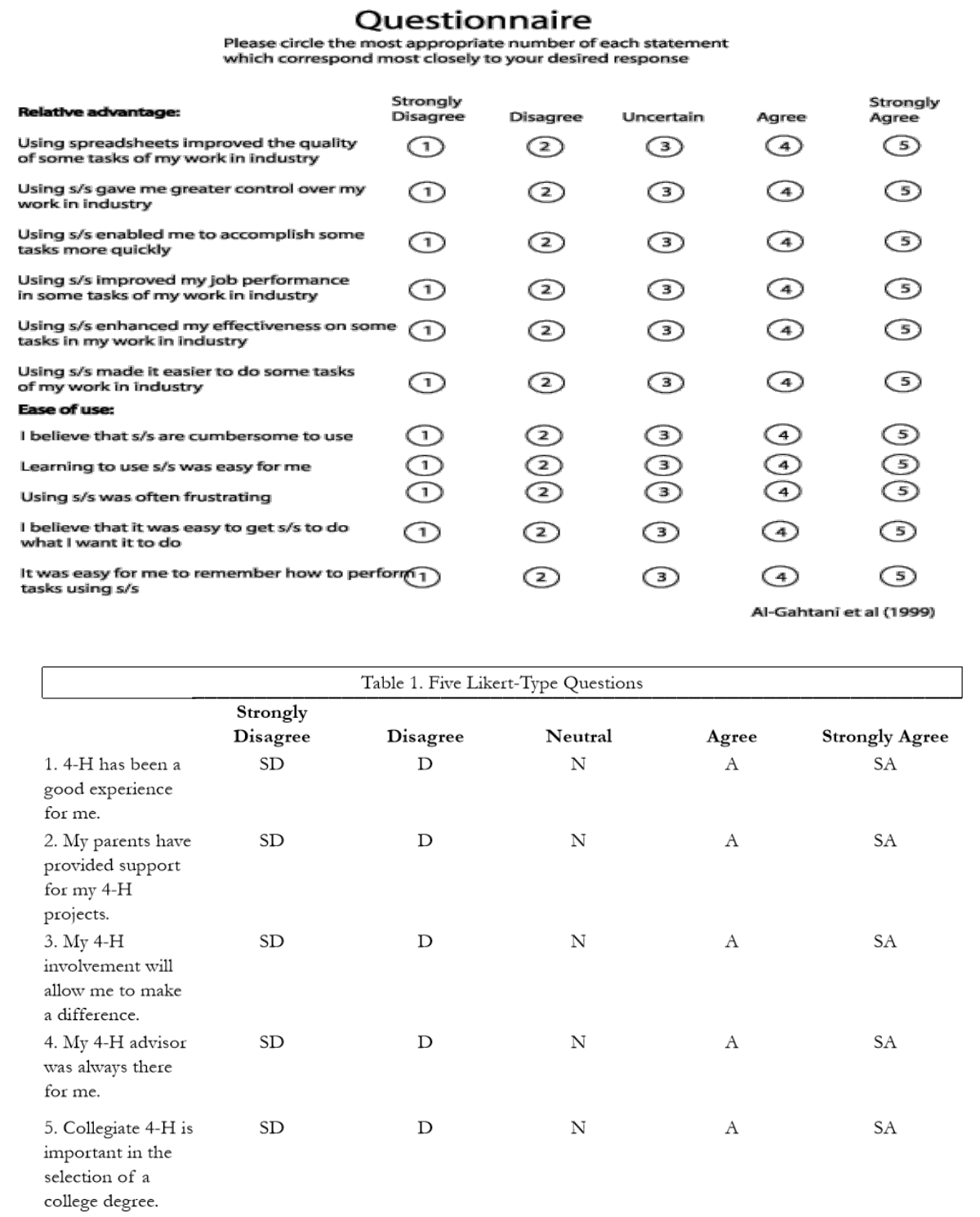
In questionnaire design, Likert scale is common particularly when measuring attitudes, opinions, or behaviors. A Likert scale enables the researcher to quantify subjective responses, providing a useful tool for analysis.
To ensure clarity and validity in responses, the Likert scale should be:
- Labelled clearly: The scale’s endpoints must be distinctly defined to avoid ambiguity in respondents' answers. For example, a scale should range from “extremely brave” to “not at all brave,” rather than from “extremely brave” to “extremely shy.”
- Unipolar: The scale should measure a single dimension, such as the degree of agreement or frequency, rather than two opposing traits. This approach helps maintain focus and consistency in the responses.
Several important features of the Likert scale are
- Total or Average Responses: Likert scales typically involve aggregating the answers from multiple items (questions). This aggregation allows researchers to calculate totals or averages, providing a clearer measure of a respondent’s attitudes or perceptions.
- Reliability: Likert scales are more reliable than individual items because they consist of multiple questions that measure the same underlying construct. This increases the consistency of the data.
- Interval Scale Properties: Due to their multiple items, Likert scales can often be treated as interval scales, meaning that researchers can apply descriptive statistics such as means and standard deviations. This allows for deeper statistical analysis.
- Presenting Results: When reporting results from Likert scales, it's important not only to present the means and standard deviations but also the frequency or percentage of respondents selecting each option. This provides a fuller understanding of how respondents are distributed across the scale's range, helping readers interpret the data at a more granular level.
Does the measure capture what matters? Do not measure what is easy; instead, measure what is needed.
Is the measure believable? Will it be viewed as a reasonable and appropriate way to capture the information sought?
How well does the measure capture what it is supposed to? Example: Are waiting lists a valid measure of demand?
Indicates the precision and stability of the instrument across repeated trials. Considers whether consistent results are obtained under similar conditions.
Examples: Birth weights of newborns measured with scales. Speeds recorded using a stopwatch.